If you are researching hair transplant options in India, you have almost certainly come across two terms — FUE and NHDT. Both are hair restoration techniques. Both promise natural results. But they are fundamentally different in how they work, what the recovery looks like, and the quality of results you can expect.
As the Founder of NHDT (Natural High Density Hair Transplant), I want to give you an honest, clear comparison so you can make an informed decision — not just a marketing pitch.
The short answer: FUE is a good technique. NHDT is an advanced evolution of it — designed to eliminate its key limitations while delivering significantly higher density and a more natural result.
What is FUE (Follicular Unit Extraction)?
FUE is currently the most widely used hair transplant technique globally. It involves extracting individual hair follicles from the donor area (typically the back of the scalp) using a small circular punch tool, and then implanting them into the balding area using incisions made by a scalpel or needle.
FUE was a major advancement over the older FUT (strip) method because it eliminated the long linear scar. However, FUE still has limitations that many patients discover only after the procedure.
What is NHDT (Natural High Density Hair Transplant)?
NHDT is a patented hair restoration technique developed and founded by me, Dr Viral Desai, exclusively available at my clinics in Mumbai and Pune. NHDT was designed from the ground up to address every key limitation of FUE — and to take the quality of results to a level that standard FUE cannot achieve.
In NHDT, hair follicles are extracted using a specialised titanium-coated tool with a diameter of just 0.7mm — significantly smaller than standard FUE punches. The implantation is performed using a precision implanter that controls the exact angle, depth, and direction of every single follicle placed.
The result is a higher-density, completely natural hairline with zero cuts and zero stitches.
NHDT vs FUE — Side by Side Comparison
| Factor | FUE | NHDT |
|---|---|---|
| Scarring | Micro-punch scars in donor area | Zero visible scars |
| Pain during procedure | Moderate — local anaesthesia required | Near-zero pain |
| Incisions at implantation | Yes — scalpel or needle incisions | No incisions — direct implanter placement |
| Density achievable | Moderate — limited by manual placement | High density — precision implanter control |
| Natural hairline | Good | Excellent — precise angle, depth, direction |
| Downtime / recovery | 7–10 days visible recovery | Minimal — most patients resume in 3–5 days |
| Graft survival rate | Good | Higher — reduced handling time, titanium tool |
| Suitable for all hair types | Yes | Yes — including curly and fine Indian hair |
| Results permanence | Permanent | Permanent |
| Availability in India | Widely available | Exclusively at Dr Viral Desai's clinics |
The Key Difference — Implantation
The biggest difference between FUE and NHDT is not extraction — it is implantation. In standard FUE, the surgeon first makes incisions in the recipient area with a scalpel or needle, and then separately places grafts into those incisions. This two-step process increases handling time for each graft, risks trauma to surrounding follicles, and makes it harder to control the precise direction of hair growth.
In NHDT, a specialised precision implanter places each graft directly into the scalp in a single controlled motion — no separate incision step. This means less trauma, faster procedure time, higher graft survival, and — most importantly — complete control over the angle and direction of each hair follicle. The result looks exactly like natural hair growth because it mirrors it perfectly.
Can You See the Difference in Results?
Yes — significantly. Standard FUE results can look slightly patchy at the hairline when examined closely, because the angle and direction of individual follicles is harder to control with the incision-first method. NHDT results are consistently described as undetectable — even by other hair surgeons. This is because every follicle is placed to mimic the natural growth pattern of that individual patient.
"The goal of NHDT is not just to transplant hair — it is to restore it so naturally that no one, not even another surgeon, can tell you had a procedure." — Dr Viral Desai
Which One is Right for You?
If you are considering a hair transplant in Mumbai, the honest answer is that NHDT is the superior technique for anyone who wants the highest possible density, the most natural result, and zero visible scarring. FUE is a good option if NHDT is not available to you — but if you have access to NHDT, there is no reason to settle for less.
The best way to find out which treatment is right for your specific pattern of hair loss, donor area quality, and density goals is a personalised consultation. Every patient is different — the number of grafts needed, the technique best suited to your hair type, and the realistic expectations for your result all require an individual assessment.
Frequently Asked Questions
Is NHDT more expensive than FUE?
NHDT is a premium, patented technique and is priced accordingly. However, the cost difference is justified by the significantly better results, lower downtime, and the fact that many FUE patients require a second procedure to achieve the density NHDT delivers in one sitting. Book a consultation for a personalised cost estimate.
How long does NHDT take?
A typical NHDT session takes 6–8 hours depending on the number of grafts required. The procedure is done in a single day at our Mumbai or Pune clinic.
Is NHDT safe?
Yes. NHDT is performed by Dr Viral Desai, a board-certified M.Ch. D.N.B. Cosmetic and Plastic Surgeon with over 20 years of experience. The technique uses single-use titanium-coated tools and follows the highest clinical protocols. Thousands of successful procedures have been performed since NHDT was introduced.
How soon will I see results after NHDT?
Initial shedding of transplanted hair occurs in weeks 2–4 — this is completely normal. New growth begins around month 3. Significant density is visible by month 6. Full, final results are seen at 12 months.
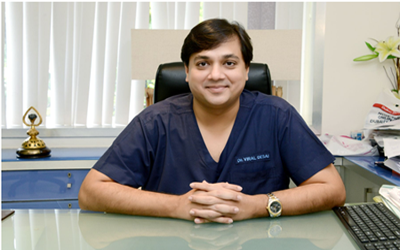
Dr Viral Desai — Founder, NHDT India
M.Ch., D.N.B. Cosmetic and Plastic Surgeon. Founder and Medical Director of NHDT (Natural High Density Hair Transplant) India. Member of ISAPS, ISHRS, APSI. Practising since 2003.
Ready to find out if NHDT is right for you?
Book a personalised consultation with Dr Viral Desai. Clinics in Mumbai and Pune.
Book a Consultation →